Invented targets and allocations, not recommended budgets. The cash model still needs start dates, receipts and costs.
“Raising $1.2M for hiring and growth” states an amount and two spending categories. A reader still has to work out what the company expects to achieve, when it expects to achieve it and why this budget is enough to attempt it.
Build the ask slide from an operating plan. YC’s seed-fundraising guide connects the amount raised to a believable plan and the next fundable milestone. Use that planning principle here; its historical salary and runway examples are not a budget for your company. Describe the next result you want to reach, the work required and the assumptions behind the cost. Slide design comes after those decisions.
Name an observable milestone.
“Scale the business” is difficult to evaluate. A more useful milestone describes something you could check on a particular date: a technical capability demonstrated under specified conditions, a customer group renewing, or a repeatable way to acquire paying accounts.
The milestone should address a consequential uncertainty. If customers like a prototype but nobody has paid, willingness to pay may need attention. If customers pay but implementation takes months of founder time, delivery may be the next constraint.
Pick a result that helps explain the next phase of the company. Avoid assembling a list of attractive metrics simply because they look balanced on a slide. The point is to show what the work is intended to establish.
Invented example / Planning statement
“We plan to use this round to test whether finance teams outside our founders’ network will pay for the product and complete onboarding without a founder leading each setup.”
Make the targets explicit. For the same invented company, a completed version could read:
Illustrative targets / No benchmark implied
“Raise $1.2M in January 2027 to reach 20 paying finance teams by June 2028. At least 15 complete data setup and their first revenue report within five working days, without a founder leading the setup. Eight of the first ten teams eligible for a six-month renewal renew on paid terms.”
The targets define paying status, timing, an onboarding event and a renewal group. They remain assumptions to test. Their suitability depends on the product, price, sales cycle and resources in the operating plan.
Build the amount from the work.
List the people and costs required to attempt the milestone. Include when each cost begins, whether it is recurring and which costs vary with customer volume. A hire starting in month seven has a different effect from one starting on day one.
For illustration, suppose a company plans to raise $1.2M. Its model assigns $600,000 to product and engineering, $240,000 to customer acquisition experiments, $180,000 to implementation and operations, and $180,000 to a reserve. Those allocations total $1.2M.
The total is only a starting point. The model must explain headcount, start dates, cash already available, expected receipts and other material costs. These numbers are an invented example of a budget structure, with no claim that they suit another company.
A simple division of $1.2M by $60,000 of monthly net cash outflow gives twenty months. That arithmetic assumes a constant outflow and the full amount being available. It cannot establish actual runway when hiring, revenue, collections or one-off costs change. Use a month-by-month cash model for the plan you present.
Show the relationship on the slide.
Give the amount, the intended planning horizon and the milestone a shared visual structure. A reader should be able to move from “what you are raising” to “what the money allows you to attempt” without interpreting a pie chart first.
Use a small number of workstreams beside the headline. In the fictional example, product work could support independent onboarding; sales experiments could test a defined customer group; implementation work could measure the effort needed to activate an account.
For each workstream, name a deliverable or observable result. Put detailed hiring assumptions, the monthly model and sensitivity cases in the appendix. Keep the important qualification on the main slide if removing it would make the plan misleading.
Make the uncertainty visible.
A target is a target. Label projected revenue, planned hiring and expected dates accordingly. Explain the assumptions that materially affect the plan, especially where you have limited evidence.
Show what you would change if an assumption fails. If onboarding remains labour-intensive, would you narrow the customer segment, change the product or delay sales hiring? You do not need a separate contingency slide for every possibility. You do need enough thought behind the ask to discuss a different outcome.
Reaching a milestone does not guarantee a further round. Describe the operating result the company aims to achieve and the choices it may enable, without promising that another investor will finance the next step.
Check the ask against the rest of the deck.
Compare the ask with the traction, product and business-model slides. If the plan assumes a shorter sales cycle than you have observed, make the reason explicit. If it depends on a new buyer, distinguish that experiment from the existing customer evidence.
Sequoia’s business-plan guide treats the business model, team, financials and longer-term vision as parts of the company’s explanation. Use the ask to connect those parts to the immediate operating plan.
Before sending the deck, ask a fresh reader to describe what the company is raising, what it plans to accomplish and which assumption they would test first. If they can answer from the slide and its supporting model, your next conversation can start with the plan itself.
See the slide in context.
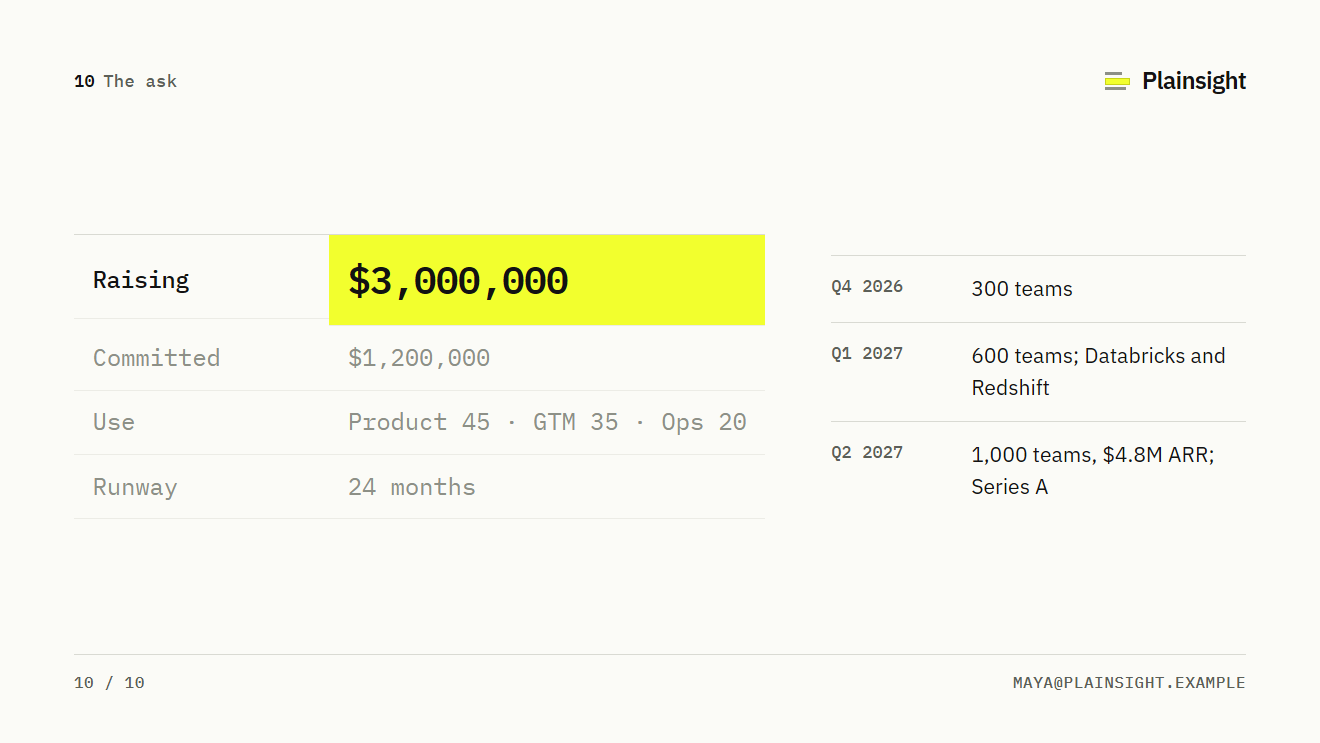
The amount and the milestones share a single view. The operating model must still support the timeline and costs.
Open this slide in the full example deck
Put it to work / TPD exercise
Connect the round to a testable result.
- Define the milestone and date.
- Map the workstreams and assumptions.
- Check the monthly cash plan.